Most CAPAs are closed. Far fewer are proven effective. That gap rarely originates in the corrective action itself - it originates upstream, in the handoff between the function that identified the hazard and the function responsible for closing it out. An operator flags a corroded valve on a routine walkdown and logs it in a shift log that never leaves the unit office. Maintenance opens a work order against the same asset three months later, unaware the hazard observation exists. A process safety event eventually traces back to that valve, and the root cause analysis (RCA) finds two records, two owners, and no thread connecting them.
This is not a training failure or a discipline failure. It is a structural one. In most industrial organizations, Health, Safety, and Environment (HSE) performance data is distributed across functions that were never designed to talk to each other - operations logs incidents, maintenance tracks equipment history in a CMMS, human resources manages competency and training records, and the HSE department maintains its own CAPA register, usually in a spreadsheet or a legacy module bolted onto a broader business system. Each function is, on its own terms, doing its job. None of them, individually, can see the pattern that an RCA needs in order to work.
The consequence is not abstract. Under OSHA's Process Safety Management standard, 29 CFR 1910.119, employers covered by the rule must document management of change (MOC), incident investigation, and mechanical integrity activity in a way that demonstrates the hazard was actually addressed - not merely logged. When an auditor requests all corrective and preventive actions tied to contractor-related incidents over the preceding twelve months, the organization is not being asked whether it has a safety program. It is being asked whether that program produces a single, defensible record of what happened, who owned it, and whether the fix held. Most organizations discover, in that moment, that the answer lives in four different systems and at least one email thread.
The International Labour Organization estimates that 2.3 million workers die every year from work-related accidents and diseases (ILO, Safety and Health at Work). The figure is sobering not because industry lacks safety programs, but because so much of that toll originates in hazards that were, in fact, identified somewhere in the organization before they became fatal. The gap between identification and prevention is rarely a knowledge gap. It is an integration gap - a failure to connect what one function sees to what another function must act on.
That is the argument of this article. HSE performance is no longer determined by how good any single department is at its job. It is determined by how well operations, maintenance, engineering, quality, human resources, contractors, and executive leadership share a common operational picture of risk. Organizations that have closed that gap are not necessarily larger or better resourced than their peers. They are simply more integrated.
The Cost of Operating Without Integrated HSE Management
When functional roles operate in isolation, the organization does not simply lose efficiency - it loses visibility into leading indicators before they convert into lagging ones. The Center for Chemical Process Safety (CCPS), in its process safety metrics guidance, has long argued that lagging indicators such as recordable incidents and process safety events are the wrong place to start measuring performance, because by the time they occur, the leading indicators - overdue MOC actions, expired mechanical integrity inspections, unclosed near-miss investigations - have usually been degrading for months. The complication is that leading indicators are almost always owned by a different function than the one reviewing overall HSE performance. Maintenance owns inspection schedules. Operations owns near-miss reporting. Engineering owns MOC. HSE owns the CAPA register meant to tie them together, but frequently sees only a fraction of what is actually happening in the field.
The financial dimension is not trivial. The National Safety Council's Injury Facts report has repeatedly shown that the average cost of a medically consulted workplace injury runs into the tens of thousands of dollars once direct and indirect costs - investigation time, lost productivity, replacement labor, and insurance impact - are included. Multiply that by the number of incidents that trace back to a hazard already known to a function that never routed it to the people who could act on it, and the cost of the silo stops being theoretical.
Consider a mid-sized specialty chemicals plant running three shifts. A night-shift operator notes a recurring pressure fluctuation on a reactor feed line and records it in the shift log. Day-shift maintenance reviews CMMS work orders but not shift logs. Two weeks later, the same fluctuation triggers a relief valve lift - a Near Miss serious enough to warrant a Tier 2 process safety event classification under API RP 754. The RCA finds the original observation sitting undocumented in a system maintenance never reviews. No individual failed. The structure did.
The Convergence Loop: A Framework for Cross-Functional HSE Ownership
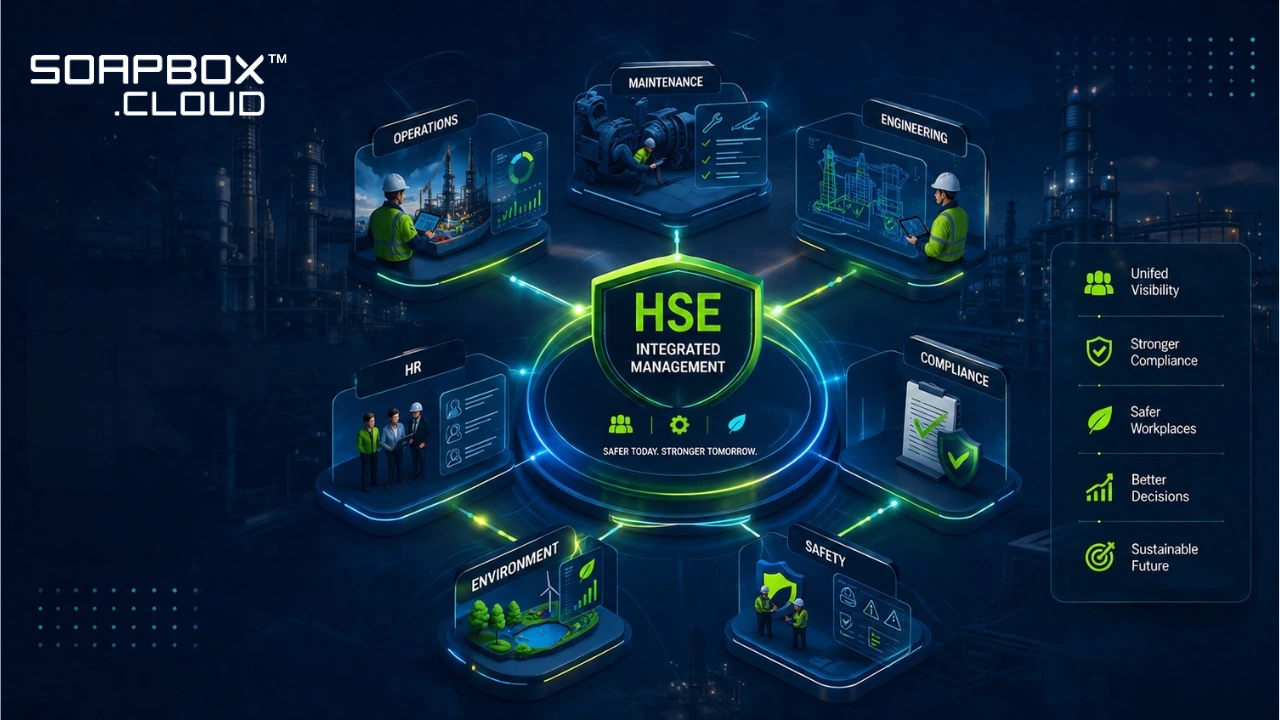
Closing this gap takes more than encouraging departments to communicate better. It takes a structural framework that assigns a specific function to each stage of the risk lifecycle and turns the handoff between functions into an auditable event rather than an informal courtesy. Across engagements advising industrial operators on CAPA and RCA program design, four recurring stages surface - a sequence worth naming on its own terms: the Convergence Loop.
Organizations that map their existing HSE processes onto this loop typically find reasonably strong Capture and adequate Close, and almost no structured Connect or Confirm - precisely where cross-functional risk goes unmanaged.
A spreadsheet can hold any one stage of the Convergence Loop. None of them can hold all four in a way that survives an audit.
How Functional Integration Strengthens Operational Risk Management
When Capture, Connect, Confirm, and Close operate as a single loop rather than four departmental habits, the quality of root cause analysis improves in a way that is measurable rather than aspirational. An RCA conducted with visibility into maintenance history, MOC records, and prior Near Miss data will consistently identify systemic root causes - inadequate mechanical integrity intervals, unaddressed MOC gaps, insufficient competency verification - rather than stopping at the proximate cause, which is usually an individual action or a single equipment failure.
HSE UK's RIDDOR (Reporting of Injuries, Diseases and Dangerous Occurrences Regulations) reporting has consistently shown that a meaningful share of dangerous occurrences involve failures of established control measures rather than the absence of controls altogether - controls that existed on paper in one function but were never verified as still valid by another. Integration does not create new controls. It verifies that the controls each function believes are in place actually are, and that the function relying on them can see that verification directly.
Operational risk management, in this sense, shifts from a periodic audit exercise to a continuous state any function can query at any time. A maintenance planner scheduling mechanical integrity inspections can see whether a related MOC is still open. A contractor safety coordinator approving a work permit can see whether the asset in question carries an open CAPA from a prior Near Miss. An HSE manager preparing for a PSM compliance audit can produce, without a manual reconciliation exercise, a defensible record of every corrective action tied to contractor incidents in the preceding twelve months - the exact request that so often exposes the silo in the first place.
The Role of Digital HSE Platforms in Connecting Teams
Digital HSE transformation is often described as moving paper processes into software. That framing understates what is actually required. The technical challenge is not digitization - most organizations digitized incident reporting, audit checklists, and training records years ago, usually one function at a time. The challenge is that those digitized systems were built independently, by different functions, on different timelines, and rarely share a common data model. A CMMS records asset history. A learning management system records training completions. An incident management module records investigations. Each is a genuine improvement over paper. None of them, on its own, closes the Connect and Confirm gaps described above.
A platform built for integrated HSE management treats hazard identification, MOC, CAPA, RCA, and training as connected records referencing the same assets, the same personnel, and the same regulatory obligations - rather than as separate modules that happen to share a login. That is the practical difference between an HSE software portfolio and an integrated HSE management system: the former digitizes departmental processes; the latter makes the relationships between those processes visible and auditable.
For today's industrial organizations - not only the largest enterprises with dedicated process safety departments, but growing operators bringing on their first full-time HSE manager, or multi-site businesses standardizing practice across facilities that grew up with different tools - this distinction matters more, not less. A smaller organization has fewer people available to manually reconcile disconnected systems. Integration is not a maturity milestone reserved for the largest operators. It is often more urgent for organizations without the staff to paper over the gaps.
Building a Culture Where Safety Is Everyone's Responsibility
None of this replaces the human element of HSE performance. A Convergence Loop built on strong data architecture still depends on an operator willing to log the pressure fluctuation, a contractor willing to raise a hand about an expired certification, and a supervisor willing to treat a Near Miss as a leading indicator rather than a paperwork obligation. But culture and integration are not competing investments - they reinforce one another. Workers report hazards more consistently when they can see that a prior report led to a visible, connected action. Silence grows fastest in organizations where reporting seems to disappear into a system no other function ever reviews.
This is where cross-functional collaboration in HSE stops being a management theory and becomes an observable behavior. When a maintenance technician can see, in the same interface an operator uses, that a hazard they logged directly informed an MOC review, the incentive to report increases. When an HSE manager can show site leadership a single operational risk picture spanning operations, maintenance, and contractors - rather than three departmental reports reconciled the night before a leadership meeting - safety conversations shift from defending departmental performance to solving shared problems. That shift, more than any single training initiative, produces the safety culture most organizations say they want and few consistently achieve.
Working through what functional integration should look like across operations, maintenance, contractors, and HSE at your own sites? Soapbox's Early Adopters Programme is currently partnering with a small group of industrial operators building exactly this kind of connected risk picture - details on the Early Adopters Programme page.
Why Integration of Functional Roles Is the Key to Integrated HSE Management
Most CAPAs are closed. Far fewer are proven effective. That gap rarely originates in the corrective action itself - it originates upstream, in the handoff between the function that identified the hazard and the function responsible for closing it out. An operator flags a corroded valve on a routine walkdown and logs it in a shift log that never leaves the unit office. Maintenance opens a work order against the same asset three months later, unaware the hazard observation exists. A process safety event eventually traces back to that valve, and the root cause analysis (RCA) finds two records, two owners, and no thread connecting them.
This is not a training failure or a discipline failure. It is a structural one. In most industrial organizations, Health, Safety, and Environment (HSE) performance data is distributed across functions that were never designed to talk to each other - operations logs incidents, maintenance tracks equipment history in a CMMS, human resources manages competency and training records, and the HSE department maintains its own CAPA register, usually in a spreadsheet or a legacy module bolted onto a broader business system. Each function is, on its own terms, doing its job. None of them, individually, can see the pattern that an RCA needs in order to work.
The consequence is not abstract. Under OSHA's Process Safety Management standard, 29 CFR 1910.119, employers covered by the rule must document management of change (MOC), incident investigation, and mechanical integrity activity in a way that demonstrates the hazard was actually addressed - not merely logged. When an auditor requests all corrective and preventive actions tied to contractor-related incidents over the preceding twelve months, the organization is not being asked whether it has a safety program. It is being asked whether that program produces a single, defensible record of what happened, who owned it, and whether the fix held. Most organizations discover, in that moment, that the answer lives in four different systems and at least one email thread.
The International Labour Organization estimates that 2.3 million workers die every year from work-related accidents and diseases (ILO, Safety and Health at Work). The figure is sobering not because industry lacks safety programs, but because so much of that toll originates in hazards that were, in fact, identified somewhere in the organization before they became fatal. The gap between identification and prevention is rarely a knowledge gap. It is an integration gap - a failure to connect what one function sees to what another function must act on.
That is the argument of this article. HSE performance is no longer determined by how good any single department is at its job. It is determined by how well operations, maintenance, engineering, quality, human resources, contractors, and executive leadership share a common operational picture of risk. Organizations that have closed that gap are not necessarily larger or better resourced than their peers. They are simply more integrated.
The Cost of Operating Without Integrated HSE Management
When functional roles operate in isolation, the organization does not simply lose efficiency - it loses visibility into leading indicators before they convert into lagging ones. The Center for Chemical Process Safety (CCPS), in its process safety metrics guidance, has long argued that lagging indicators such as recordable incidents and process safety events are the wrong place to start measuring performance, because by the time they occur, the leading indicators - overdue MOC actions, expired mechanical integrity inspections, unclosed near-miss investigations - have usually been degrading for months. The complication is that leading indicators are almost always owned by a different function than the one reviewing overall HSE performance. Maintenance owns inspection schedules. Operations owns near-miss reporting. Engineering owns MOC. HSE owns the CAPA register meant to tie them together, but frequently sees only a fraction of what is actually happening in the field.
The financial dimension is not trivial. The National Safety Council's Injury Facts report has repeatedly shown that the average cost of a medically consulted workplace injury runs into the tens of thousands of dollars once direct and indirect costs - investigation time, lost productivity, replacement labor, and insurance impact - are included. Multiply that by the number of incidents that trace back to a hazard already known to a function that never routed it to the people who could act on it, and the cost of the silo stops being theoretical.
Consider a mid-sized specialty chemicals plant running three shifts. A night-shift operator notes a recurring pressure fluctuation on a reactor feed line and records it in the shift log. Day-shift maintenance reviews CMMS work orders but not shift logs. Two weeks later, the same fluctuation triggers a relief valve lift - a Near Miss serious enough to warrant a Tier 2 process safety event classification under API RP 754. The RCA finds the original observation sitting undocumented in a system maintenance never reviews. No individual failed. The structure did.
Why HSE Is No Longer the Responsibility of One Department
For much of the last three decades, HSE was organized as a department: specialists who wrote procedures, conducted audits, and investigated incidents after the fact. That model made sense when hazards were largely mechanical and confined to a single unit. It makes far less sense in operations characterized by Simultaneous Operations (SIMOPS) - turnarounds running alongside live production, contractor crews working adjacent to permit-holders, capital projects overlapping with routine maintenance. In that environment, risk is generated at the intersection of functions, not within any one of them.
ISO 45001, the international standard for occupational health and safety management systems published in 2018, reflects this shift directly. Unlike its predecessor OHSAS 18001, ISO 45001 places explicit weight on worker participation and top management accountability as integrated components of the management system, not as adjuncts to a safety department's procedures. HSE UK's own guidance on major hazard control similarly stresses that effective risk management depends on the interaction between technical, procedural, and behavioral controls - controls that are, by definition, distributed across engineering, operations, and human resources.
Consider a turnaround at a refinery involving permanent staff and multiple contractor crews under a single Permit to Work system. Operations manages the permits. Contractor safety coordinators manage crew competency and inductions. Engineering manages the MOC for temporary piping modifications. HR verifies training records for contractor personnel entering confined spaces. If any one of these functions acts without visibility into what the others have approved - a permit issued without confirming a contractor's confined space certification is current, for instance - the organization creates a hazard that no single department caused and no single department can fully see. HSE, in this environment, is not a department. It is a discipline every function practices, coordinated through shared data rather than separate registers.
The Convergence Loop: A Framework for Cross-Functional HSE Ownership
Closing this gap takes more than encouraging departments to communicate better. It takes a structural framework that assigns a specific function to each stage of the risk lifecycle and turns the handoff between functions into an auditable event rather than an informal courtesy. Across engagements advising industrial operators on CAPA and RCA program design, four recurring stages surface - a sequence worth naming on its own terms: the Convergence Loop.
the point where a hazard, Near Miss, or non-conformance first enters the system, regardless of which function observes it. The discipline is not who reports it, but that it enters one system of record rather than a departmental log only its author will read again.
the stage where that record is linked to every function with a legitimate interest in it - a recurring equipment fault connecting automatically to maintenance's asset history, to engineering's MOC log, and to HSE's CAPA register. Connection is a data architecture decision, not a communication style.
the stage where accountable owners across functions verify that the corrective action addresses the root cause identified in the RCA, not merely the symptom first observed. This is where siloed organizations most often fail, because the function closing the CAPA is rarely the function that owns the asset or process.
the point at which the action is verified as effective - not simply completed - with evidence retained in a form that can answer an auditor's question about any contractor incident, RCA, or MOC from the past year without a records search across five systems.
Organizations that map their existing HSE processes onto this loop typically find reasonably strong Capture and adequate Close, and almost no structured Connect or Confirm - precisely where cross-functional risk goes unmanaged.
A spreadsheet can hold any one stage of the Convergence Loop. None of them can hold all four in a way that survives an audit.
How Functional Integration Strengthens Operational Risk Management
When Capture, Connect, Confirm, and Close operate as a single loop rather than four departmental habits, the quality of root cause analysis improves in a way that is measurable rather than aspirational. An RCA conducted with visibility into maintenance history, MOC records, and prior Near Miss data will consistently identify systemic root causes - inadequate mechanical integrity intervals, unaddressed MOC gaps, insufficient competency verification - rather than stopping at the proximate cause, which is usually an individual action or a single equipment failure.
HSE UK's RIDDOR (Reporting of Injuries, Diseases and Dangerous Occurrences Regulations) reporting has consistently shown that a meaningful share of dangerous occurrences involve failures of established control measures rather than the absence of controls altogether - controls that existed on paper in one function but were never verified as still valid by another. Integration does not create new controls. It verifies that the controls each function believes are in place actually are, and that the function relying on them can see that verification directly.
Operational risk management, in this sense, shifts from a periodic audit exercise to a continuous state any function can query at any time. A maintenance planner scheduling mechanical integrity inspections can see whether a related MOC is still open. A contractor safety coordinator approving a work permit can see whether the asset in question carries an open CAPA from a prior Near Miss. An HSE manager preparing for a PSM compliance audit can produce, without a manual reconciliation exercise, a defensible record of every corrective action tied to contractor incidents in the preceding twelve months - the exact request that so often exposes the silo in the first place.
The Role of Digital HSE Platforms in Connecting Teams
Digital HSE transformation is often described as moving paper processes into software. That framing understates what is actually required. The technical challenge is not digitization - most organizations digitized incident reporting, audit checklists, and training records years ago, usually one function at a time. The challenge is that those digitized systems were built independently, by different functions, on different timelines, and rarely share a common data model. A CMMS records asset history. A learning management system records training completions. An incident management module records investigations. Each is a genuine improvement over paper. None of them, on its own, closes the Connect and Confirm gaps described above.
A platform built for integrated HSE management treats hazard identification, MOC, CAPA, RCA, and training as connected records referencing the same assets, the same personnel, and the same regulatory obligations - rather than as separate modules that happen to share a login. That is the practical difference between an HSE software portfolio and an integrated HSE management system: the former digitizes departmental processes; the latter makes the relationships between those processes visible and auditable.
For today's industrial organizations - not only the largest enterprises with dedicated process safety departments, but growing operators bringing on their first full-time HSE manager, or multi-site businesses standardizing practice across facilities that grew up with different tools - this distinction matters more, not less. A smaller organization has fewer people available to manually reconcile disconnected systems. Integration is not a maturity milestone reserved for the largest operators. It is often more urgent for organizations without the staff to paper over the gaps.
Building a Culture Where Safety Is Everyone's Responsibility
None of this replaces the human element of HSE performance. A Convergence Loop built on strong data architecture still depends on an operator willing to log the pressure fluctuation, a contractor willing to raise a hand about an expired certification, and a supervisor willing to treat a Near Miss as a leading indicator rather than a paperwork obligation. But culture and integration are not competing investments - they reinforce one another. Workers report hazards more consistently when they can see that a prior report led to a visible, connected action. Silence grows fastest in organizations where reporting seems to disappear into a system no other function ever reviews.
This is where cross-functional collaboration in HSE stops being a management theory and becomes an observable behavior. When a maintenance technician can see, in the same interface an operator uses, that a hazard they logged directly informed an MOC review, the incentive to report increases. When an HSE manager can show site leadership a single operational risk picture spanning operations, maintenance, and contractors - rather than three departmental reports reconciled the night before a leadership meeting - safety conversations shift from defending departmental performance to solving shared problems. That shift, more than any single training initiative, produces the safety culture most organizations say they want and few consistently achieve.
The Question Excel Cannot Answer
Every HSE manager has, at some point, faced a version of the same question from an auditor, a board member, or a new plant manager: show me every corrective action tied to a contractor incident in the last twelve months, confirm each one was verified effective, and show which of those incidents connects to an open Management of Change. A spreadsheet can answer the first part with enough manual effort. It cannot answer the second and third parts without someone rebuilding, by hand, the exact cross-functional record the Convergence Loop is designed to maintain automatically - and rebuilding it again every time the question is asked.
That is the real test of integrated HSE management: not whether the organization can produce a CAPA register, but whether it can produce, on demand, a defensible answer to a question that spans functions nobody thought to connect at the time the data was first captured. Organizations that can answer it quickly have usually stopped treating HSE as a department's spreadsheet and started treating it as a shared operational discipline.
Working through what functional integration should look like across operations, maintenance, contractors, and HSE at your own sites? Soapbox's Early Adopters Programme is currently partnering with a small group of industrial operators building exactly this kind of connected risk picture - details on the Early Adopters Programme page.