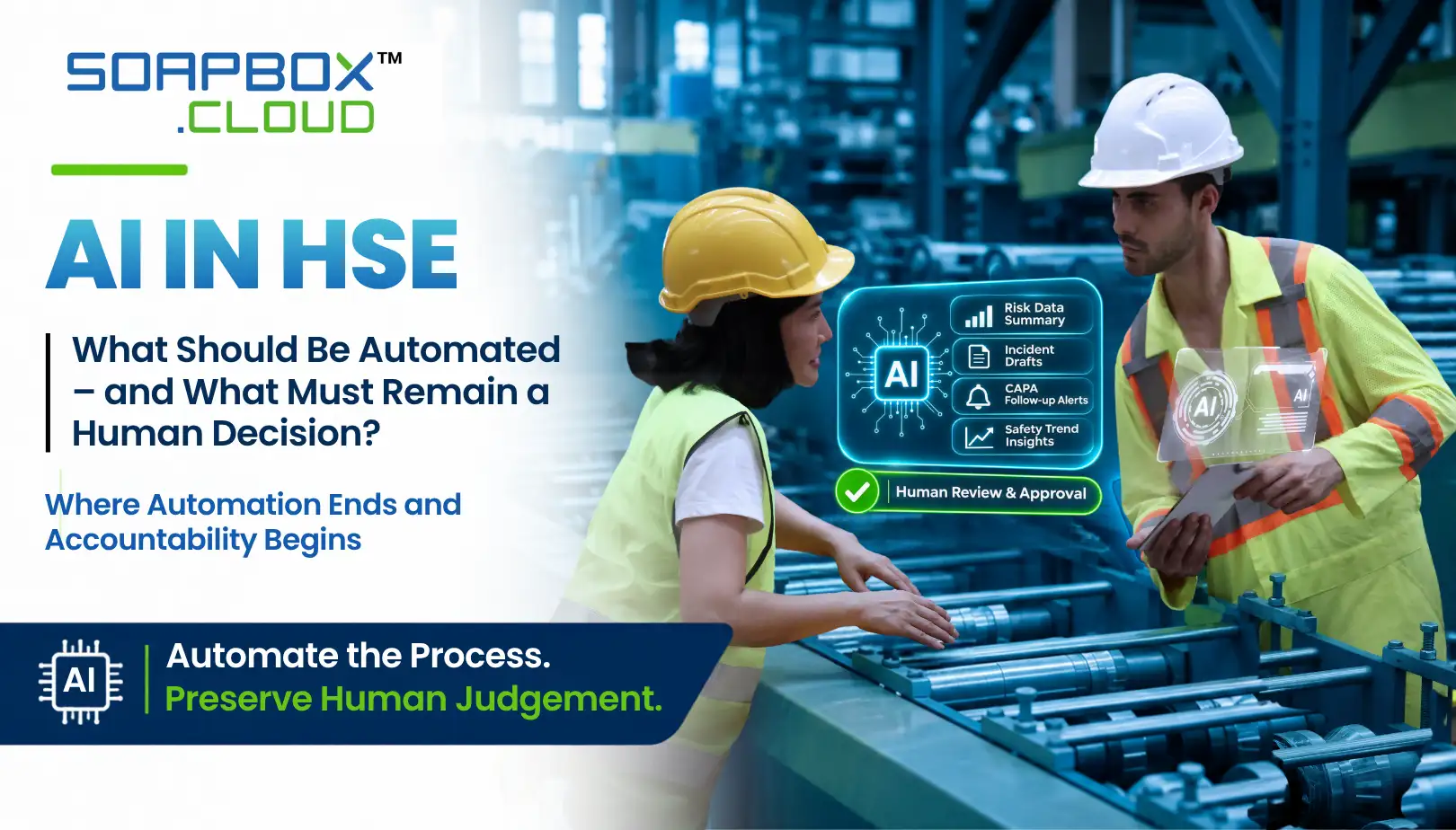
Why AI in HSE Has Outrun the Decision About Its Limits
Most HSE teams are already using AI. Far fewer have decided what it is not allowed to decide.
Ask almost any site whether AI is used in its HSE work and the answer is yes. Someone summarises witness statements in a chat window. Someone asks a tool to draft a JSA. A vendor feature scores Near Miss reports and suggests a category. Then ask a second question: which of those outputs ended up in a risk rating, an RCA or a CAPA closure, and who accepted each one? On most sites, the honest answer is that nobody knows.
That gap matters because HSE records are not working notes. A residual risk score decides how much supervision a task receives. An RCA conclusion decides what the CAPA will fix. A CAPA closure tells the next shift the problem has gone. After an incident, an investigator or regulator reads each of these as the considered judgement of a named person. If a tool wrote the judgement and a person skimmed it, the record describes a decision nobody really made.
Regulators have started to say this directly. HSE UK’s June 2026 policy statement confirms that the Health and Safety at Work etc Act 1974 applies whatever technology is used, so a risk assessment is required for uses of AI that affect health and safety. [1] HSE’s own review of AI in the sectors it regulates identified health and safety management as one of four key areas of use. [2] The ILO’s 2025 report warns that over-reliance on AI and automation may reduce human oversight and increase occupational safety and health risk. [3]
The stakes are not practical. Every serious incident involves a chain of decisions about risk, controls and corrective action, and AI is now entering that chain.
126 workers killed in work-related incidents in Great Britain in 2025/26. HSE UK, annual fatality statistics (1 July 2026) [4] | 4,337 preventable work deaths in the United States in 2024. NSC Injury Facts, Work Safety Introduction (2024 data) [5] | 48 hrs maximum time to initiate a PSM incident investigation after the incident. OSHA 29 CFR 1910.119(m)(2) [6] |
The 48-hour clock is what makes AI drafting attractive after an incident. The team requirement that sits beside it is why AI cannot decide. The question for HSE leaders is no longer whether to use AI. It is where the line sits between work a machine can do and decisions a person must own.
Why Fluent Output Gets Trusted Faster Than It Should Be
Four recurring patterns explain most of the distance between what an AI tool produces and what an HSE decision needs.
2.1 Fluent is not the same as verified
A well-structured summary reads as if it has been checked. It has not. HSE UK is explicit that AI can create and exacerbate health and safety risk as well as bring benefits. [1] A confident incident narrative can omit the one witness statement that mattered, and nothing in the formatting will warn the reader.
2.2 Review decays into sign-off
In the first weeks, the investigator reads every line of the AI draft. Later, reviewing means scrolling. HSE lists research into the impact of cognitive offloading on human performance in major hazard industries among its 2026/27 priorities. [1] When a reviewer forms a view after reading the tool’s answer, that answer becomes the anchor.
2.3 The tool reads the document, not the plant
An AI tool sees the text of the risk assessment, the permit and the investigation notes. It does not see the line that was never blanked, the detector inhibited last week or the barrier moved to give a crane access. The decision often depends on conditions that exist only in the field.
2.4 Severity potential is a rare-event judgement
HSE work is about low-frequency, high-consequence events. Tools tuned on routine reports tend to weight what is frequent. A dropped spanner and a dropped load can read almost identically in text, yet their potential severity differs enormously. Judging it takes people who know the lift and who is usually standing beneath it.
What Regulators and Standards Already Expect
No regulator has published a rulebook for AI in HSE. What exists is a set of technology-neutral duties that already decide where human judgement sits. The summary below is not exhaustive; consult the current text of each source and your own jurisdiction’s requirements.
Source | Applicability | What it expects |
HSE UK, Regulatory approach to AI (12 June 2026) | Regulator policy statement. The duties it applies are legal requirements under the 1974 Act. | Goal-setting law that applies regardless of technology. A risk assessment is required for AI uses that affect health and safety, reducing risk so far as is reasonably practicable. [1] |
OSHA 29 CFR 1910.119 (c), (e), (l), (m) | Mandatory in the U.S. for processes covered by the PSM standard. | Consult employees on PHAs; staff the PHA team with process and method expertise; manage change under written MOC procedures; start investigations within 48 hours with a process-knowledgeable team member. [6] |
ISO 45001:2018, clauses 5.4, 8.1.2, 8.1.3 | Voluntary standard. A requirement where certified or contractually committed. | Consultation and participation of workers (5.4), hierarchy of controls (8.1.2) and management of change (8.1.3). In our reading, introducing an AI tool into an HSE process is itself a change to manage. [7] |
ISO/IEC 42001:2023 | Voluntary, certifiable standard published 18 December 2023. | Sets requirements for an AI management system; ISO describes it as the world’s first. It governs the tool, not which HSE decisions may be delegated to it. [8] |
ILO, Revolutionizing health and safety (2025) | Policy report; not binding. ILO Conventions 155 and 187 provide the underlying framework. | Warns that over-reliance on AI and automation may reduce human oversight and increase OSH risk, and recommends regular risk assessment of digital technologies. [3] |
CCPS, Guidelines for Investigating Process Safety Incidents (3rd ed., 2019) | Industry good practice. Not a regulation. | Treats investigation as a structured, team-based discipline covering evidence, causal analysis and follow-up. [9] |
Read the OSHA requirement carefully. Paragraph (m)(3) does not ask for a draft. It requires an investigation team that includes at least one person knowledgeable in the process, and a contract employee where the incident involved contractor work. An AI summary can shorten the clock; it cannot be a team member. [6]
The same principle runs through the General Duty Clause, Section 5(a)(1) of the OSH Act: the duty to provide a workplace free from recognized hazards likely to cause death or serious physical harm sits with the employer, with no exception for decisions prepared by software. [10] Nothing in these sources prohibits AI. They place accountability on a person. This is not legal advice; applicability depends on jurisdiction, industry and contract terms.
The Decision Authority Line: Four Zones From Automate to Reserve
The Decision Authority Line is a proposed practical framework for deciding, task by task, how far AI may go in an HSE process. It is not a model prescribed by OSHA, ISO, HSE or CCPS. It places every task in one of four zones. Above the line, AI acts or prepares and people verify the output. Below it, a named person forms the judgement first and owns the result.
Zone | What AI may do | Who decides | Example tasks |
Zone 1 Automate | Acts on defined rules. Output checked by sampling. | Rule owner, through sample audit. | Certificate and calibration expiry alerts; CAPA due-date escalation; routing Near Miss reports to the area owner; duplicate detection; SIMOPS matrix conflict flags (flag only). |
Zone 2 Draft | Prepares content. A named person accepts, edits or rejects it first. | Named reviewer. | Incident narrative summaries; first-pass incident classification; actions extracted from audit reports; draft hazard lists from a job description; Near Miss theme clustering. |
The Decision Authority Line | |||
Zone 3 Advise | Consulted only after the person has recorded their own view. | Named competent person. | Risk rating and residual risk; RCA conclusions; CAPA effectiveness verification; MOC risk review; task-specific contractor verification; permit issue in non-routine conditions. |
Zone 4 Reserve | Not used for the decision. | Duty holder or authorised person. | Stop-work; emergency response; accepting risk above the organisation’s threshold; interviews after serious injury or fatality; disciplinary decisions; workforce consultation. |
4.1 What belongs above the line
Many HSE failures are failures of follow-up, not judgement: the certificate that expired, the CAPA that went overdue, the Near Miss report that never reached the area owner. These tasks are rule-based, high in volume and easy to check, which is where automation earns its place. Zone 2 is more delicate. AI can summarise, classify and draft, but every output is a proposal that a named person must accept before anything relies on it.
4.2 What stays below it
Below the line sit decisions that carry consequence and accountability: how much risk is acceptable, what caused an incident, whether a CAPA worked, whether a change is safe. In Zone 3 the order of work matters. The person records their own assessment first, then consults the tool, because a reviewer who reads the AI’s answer first is anchored by it. [1] Zone 4 is not delegable at all: these are decisions someone must be able to explain, in person, to the people affected.
4.3 Three placement questions
Any task can be placed with three questions. Place it in the most restrictive zone that any one of them points to.
Verifiability: Can a competent person check the output against a source record or rule in minutes? If not, it cannot sit above the line.
Consequence: What is the worst credible outcome if the output is wrong and nobody notices? Where that is serious injury or a major accident hazard, the task sits in Zone 3 or below.
Accountability: Who must defend this decision to an investigator, a regulator or the workforce? That person makes it.
4.4 A proposed rule for AI-assisted records
For tasks in Zones 2 and 3, this framework recommends that no AI output reduce a risk rating, close a CAPA, approve an MOC or release a permit until a named person has accepted it on the record, with the tool and version noted. This is a proposed governance rule, not a requirement stated by any regulator or standard. Organisations should adopt it through their own procedures, including who is competent to accept. To support this, SoapBox is developing clear tagging for AI-generated content, ensuring that auditors and investigators can easily distinguish between a human decision and an AI draft.
SoapBox is structured to support this framework. The platform allows clients to configure their workflows so that AI contributions and human acceptances are recorded in one place, mapped to the zones they define.
Three Field Scenarios Where the Tool Ran and Nobody Owned the Decision
The following scenarios illustrate how the Decision Authority Line applies in practice.
5.1 Dropped-object Near Miss on an EPC site
Field scenario
A persuasive summary, the wrong root cause
After a dropped-object Near Miss during a mobile crane lift, the investigator uses an AI tool to summarise fourteen witness statements. The tool proposes “inadequate rigging check” as the root cause and drafts a CAPA to retrain the rigging crew. The summary reads well, six other investigations are open, and the CAPA is raised the same day.
Weeks later a supervisor mentions that the exclusion barrier beneath the lift path had been moved to give the crane access. Two statements had said so, but the tool weighted the most frequent theme, not the most significant detail. The CAPA was closed on training completion and the barrier was still being moved.
The correction placed RCA conclusions in Zone 3. AI may build the timeline and summarise statements, but the investigator records their own causal analysis before reading any suggestion, and the team includes the person who knows the lift.
5.2 SIMOPS on a live hydrocarbon unit
Field scenario
Automate the flag, not the decision
During a turnaround, a rule-based check compares each new permit with the SIMOPS matrix. It is a sound Zone 1 task. But the tool blocks permit issue on any conflict, with no override path. A hot work permit near a line-breaking job is stopped, although the area authority has confirmed isolation and blanking.
Under schedule pressure, the planner splits the hot work permit into two smaller scopes. Neither triggers the flag. The conflict is still there; the system can no longer see it.
The fix kept the automated check and changed what it does. It now raises a flag to the area authority, who may proceed only with a recorded reason and a named approver. Detection stayed above the line. The decision moved back below it.
5.3 The auditor’s request
Field scenario
Twelve months, one question
An auditor asks for every risk rating, RCA conclusion, CAPA closure and MOC review completed in the last twelve months in which an AI tool was used, with the name of the person who accepted each output.
Two people spend a week interviewing team leads and searching email, because the tools ran in browser windows outside the HSE system. No record shows which version produced which draft. Several risk ratings were lowered after an AI suggestion, and nobody can say whether the assessor agreed or simply did not object.
The finding is not that AI was misused. It is that the organisation cannot show who decided. For an auditor, an investigator or a regulator, that is the finding.
Measuring Human Accountability as a Leading Indicator
API RP 754 (fourth edition, August 2026) reserves Tier 3 and Tier 4 indicators for internal use. [11] The measures below are internal proposals. They are not API RP 754 metrics.
6.1 The Reviewed-Before-Relied-On Rate
The primary measure proposed here is the Reviewed-Before-Relied-On Rate: the percentage of AI-assisted Zone 2 and Zone 3 records that carry a recorded human acceptance before they were first used.
Reviewed-Before-Relied-On Rate = (AI-assisted Zone 2 and 3 records with recorded acceptance before first use ÷ All AI-assisted Zone 2 and 3 records) × 100
The denominator should count records, not users. Reporting by tool, task type, unit and shift shows where review is thinnest.
6.2 Supporting measures
A single rate can be met on paper. These supporting measures show whether the review behind it is real:
Change rate: the share of AI drafts the reviewer edited or rejected. Near zero can signal that review has become sign-off; very high signals a tool unfit for the task.
Accepted, then found wrong: AI-assisted records later corrected after a Near Miss, audit finding or recurrence. Each should raise a CAPA on the tool or the review step.
Zone breaches: AI output used in a Zone 3 or Zone 4 decision without the person’s own judgement recorded first. The target is zero.
6.3 Three operating rules
A wrong output reopens the record. When an accepted AI output is found wrong, the risk rating, RCA or CAPA it influenced is reviewed, not just corrected.
Tools are tested like controls. Sample AI outputs against a competent reviewer’s own analysis at a defined frequency, and record the results.
Introduction is a change. A new AI tool, or a new model version, goes through MOC before it touches a Zone 2 or Zone 3 task.
What Mature Organisations Do Differently
Organisations that use AI well in HSE tend to use it in fewer places and watch those places more closely. They keep a written list of tasks by zone, agreed with operations and the workforce, and review it whenever a tool or model changes.
They apply AI first where failures are follow-up failures: overdue CAPAs, expired certificates, unrouted Near Miss reports. They hold the line on RCA conclusions, risk acceptance and permit decisions. They train reviewers as well as users: how automation bias works, what a weak summary looks like and why the reviewer records their own view first. They plan review time into turnaround and project schedules.
They also protect stop-work authority. No score, alert or AI output is accepted as a reason for a person not to stop work. And they connect AI use to the records that test it: Near Miss reports, audit findings, RCA outcomes and CAPA recurrence all point back to the decision and the tool that touched it. When an AI-assisted decision proves wrong, they can find every other decision it touched.
The One Question Excel Cannot Answer
Sooner or later, an auditor, an investigator or a regulator asks a question that needs decisions, tools and people connected across the whole site.
That question is this:
The question
“For every risk rating, RCA conclusion, CAPA closure and MOC approval in the last twelve months, which were influenced by an AI tool, which named person accepted each one, what did that person change, and has any accepted output since been found wrong?”
A spreadsheet can hold a log of every one of those answers. The difficulty is that AI use rarely starts in the spreadsheet. Drafts are produced in browser tabs and vendor features, accepted in a risk register or incident system, and recorded, if at all, from memory. Manual reconciliation is slow and unreliable, usually when the answer is needed most.
An integrated HSE platform can support a stronger process when it allows organizations to records the zone of each task, the AI contribution and the named acceptance at the point of use, and links them to the CAPAs and audit findings that test them. The technology does not replace competent reviewers or management follow-through. It makes their decisions traceable.
If your team can answer the question in minutes, your human decisions are on record. If it takes days, the record is relying on memory to show who decided.
About the author
Hasan Ahmed Sayed is an HSE professional with more than 12 years of experience across construction, EPC, industrial, shutdown and turnaround projects. As an HSE SME at SoapBox Software Solutions LLP, he brings field experience into the design of digital HSE requirements, workflows and assurance practices.
References
The links below support the factual statements and standards references in this article. Always consult the applicable current edition of a standard or regulation when establishing compliance requirements.
[1] HSE UK (12 June 2026), HSE’s regulatory approach to artificial intelligence (AI). https://press.hse.gov.uk/2026/06/12/hses-regulatory-approach-to-artificial-intelligence-ai/
[2] HSE UK (May 2025), Understanding how AI is used in HSE regulated sectors. https://www.hse.gov.uk/news/assets/docs/understand-how-ai-is-used-in-hse-regulated-sectors.pdf
[3] International Labour Organization (2025), Revolutionizing health and safety: The role of AI and digitalization at work. https://www.ilo.org/publications/revolutionizing-health-and-safety-role-ai-and-digitalization-work
[4] HSE UK (1 July 2026), Work-related fatalities in Great Britain, 2025/26 annual statistics. https://press.hse.gov.uk/tag/annual-statistics
[5] National Safety Council, Injury Facts: Work Safety Introduction (2024 data). https://injuryfacts.nsc.org/work/work-overview/work-safety-introduction/
[6] OSHA, 29 CFR 1910.119 — Process safety management of highly hazardous chemicals. See paragraphs (c), (e), (l) and (m). https://www.osha.gov/laws-regs/regulations/standardnumber/1910/1910.119
[7] ISO 45001:2018, Occupational health and safety management systems. See clauses 5.4, 8.1.2 and 8.1.3. https://www.iso.org/standard/63787.html
[8] ISO/IEC 42001:2023, Information technology — Artificial intelligence — Management system. https://www.iso.org/standard/81230.html
[9] Center for Chemical Process Safety / AIChE (2019), Guidelines for Investigating Process Safety Incidents (3rd ed.). https://www.aiche.org/ccps
[10] OSHA, Occupational Safety and Health Act of 1970, Section 5 — Duties. https://www.osha.gov/laws-regs/oshact/section5-duties
[11] American Petroleum Institute (6 August 2026), API Publishes Fourth Edition of Process Safety Performance Indicators Standard (API RP 754). https://www.api.org/news-policy-and-issues/news/2026/08/06/api-publishes-fourth-edition-process-safety-performance-indicators-standard